The Big Bang: When Personal Computers United the Geek Tribes

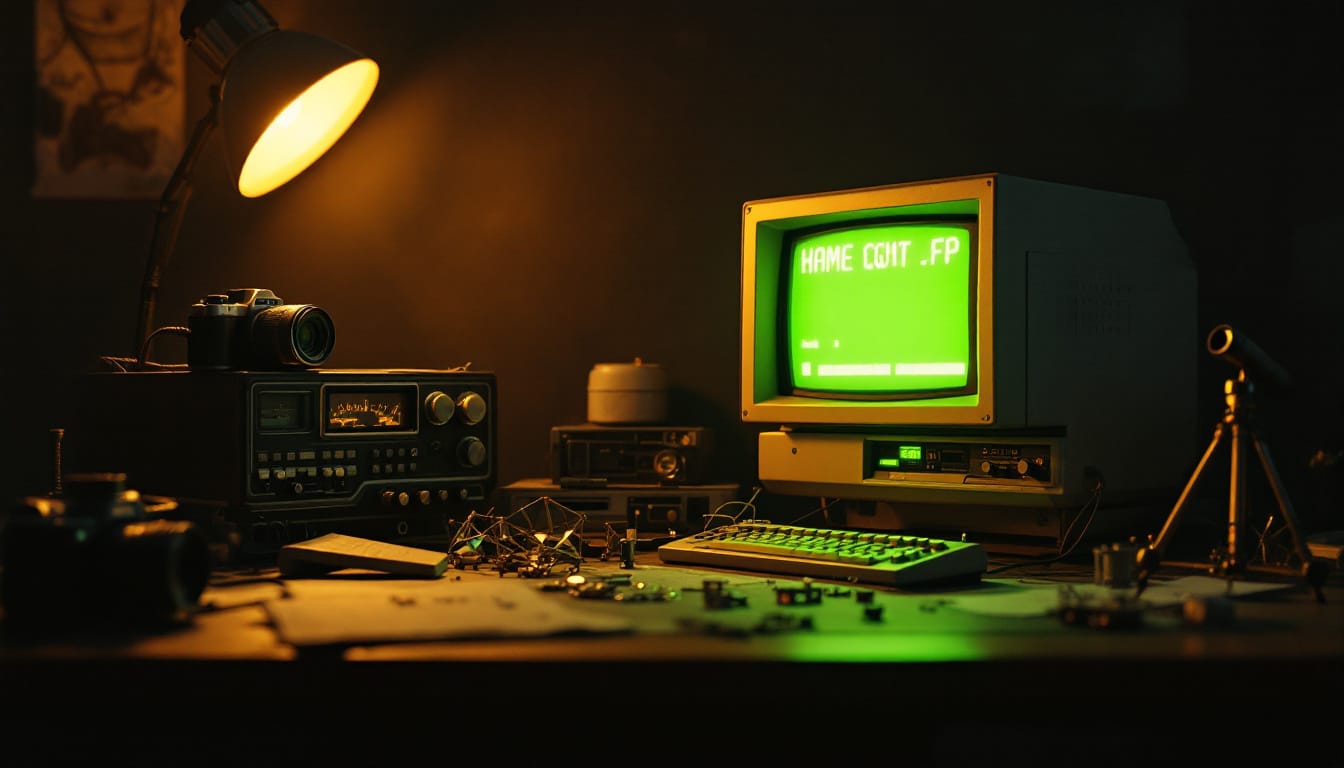
Before a single home computer existed, the geek world was already immense — it simply hadn't encountered itself yet. We were scattered across a dozen small tribes, each with its own territory, its own aromas, its own rituals.
There was the ham radio operator, sequestered at night in pursuit of a distant voice within the static, fishing for signals from the far side of the planet with an antenna instead of a rod. The photographer, who didn't merely take pictures — he developed his own film in an improvised darkroom, breathing chemical vapors, waiting for an image to emerge from the tray like a small, repeatable miracle. The mechanic, hands permanently stained, who understood engines better than he ever understood people. The one with the telescope, observing the heavens while everyone else observed the horizon. The one with the microscope, exploring a universe that nobody else bothered to notice. The Meccano child, a living-room engineer constructing bridges and cranes from tiny screws. The model-airplane builder, who would devote weeks to a single aircraft merely to watch it fly — or crash — in some empty field on a Sunday. And yes, the firearms enthusiast as well, because in that era an interest in mechanics, ballistics and precision was simply another form of technical curiosity. And, of course, the printed-circuit contingent, for those already prepared to graduate from mechanics to authentic electronics.
And in nearly every household there was one more: the handyman — the generalist geek. He specialized in nothing on that list and repaired everything: the iron, the fan, the toaster, the door lock. He required no specialized magazine, because his specialty was refusing to surrender to any broken appliance.
All those worlds coexisted, side by side, each within its own tribe, with no suspicion that they were about to be fused into one.
Then came the Big Bang.
Not that of the universe. Ours: the explosion of personal computing. Overnight, boxes with screens appeared — the RadioShack TRS-80, the Apple II, the Sinclair — and with them, a new language that anyone could acquire without requesting permission: BASIC. And in that instant, the ham operator, the photographer, the mechanic, the telescope observer and the Meccano builder all became programmers. Every single one of them.
I am not exaggerating when I say it overwhelmed us all, men and women alike. Until then, every tribe possessed its frontiers. The personal computer did not demolish those frontiers — it connected them. All at once, ten lines of code could make the screen draw, move, calculate. And that sensation — creating something from nothing with merely a keyboard and an idea — was a pleasure in a completely distinct category from anything we had previously known.
What strikes me most, contemplating it in retrospect, is that personal computing demanded no sacrifice from anyone. The ham remained a ham. The photographer continued developing his prints. But now everyone also shared a common tongue: green characters blinking on a screen, awaiting instructions.
And there, I suspect, something was born that had never quite existed before: the sensation of belonging to a single community — even if you had arrived from the telescope and I had arrived from the Meccano set. The computer was the language that finally permitted us to understand one another.
I still ask myself whether any invention will ever again unite so many scattered tribes in a single moment. Perhaps it already has — and I, still contemplating the past, simply haven't perceived it.
And always — stay focused, stay curious. I'm The Senior Geek.
Dr. Jose A. Cisneros, MD, Ph.D · seniorgeek.net
Hashtags: #RetroComputing #BASIC #TRS80 #GeekHistory #SeniorGeek
SEO keywords: history of personal computers, TRS-80, Apple II, Sinclair, BASIC, ham radio, geek tribes, retro computing