The End of Bigger: DeepSeek and the New Era of AI

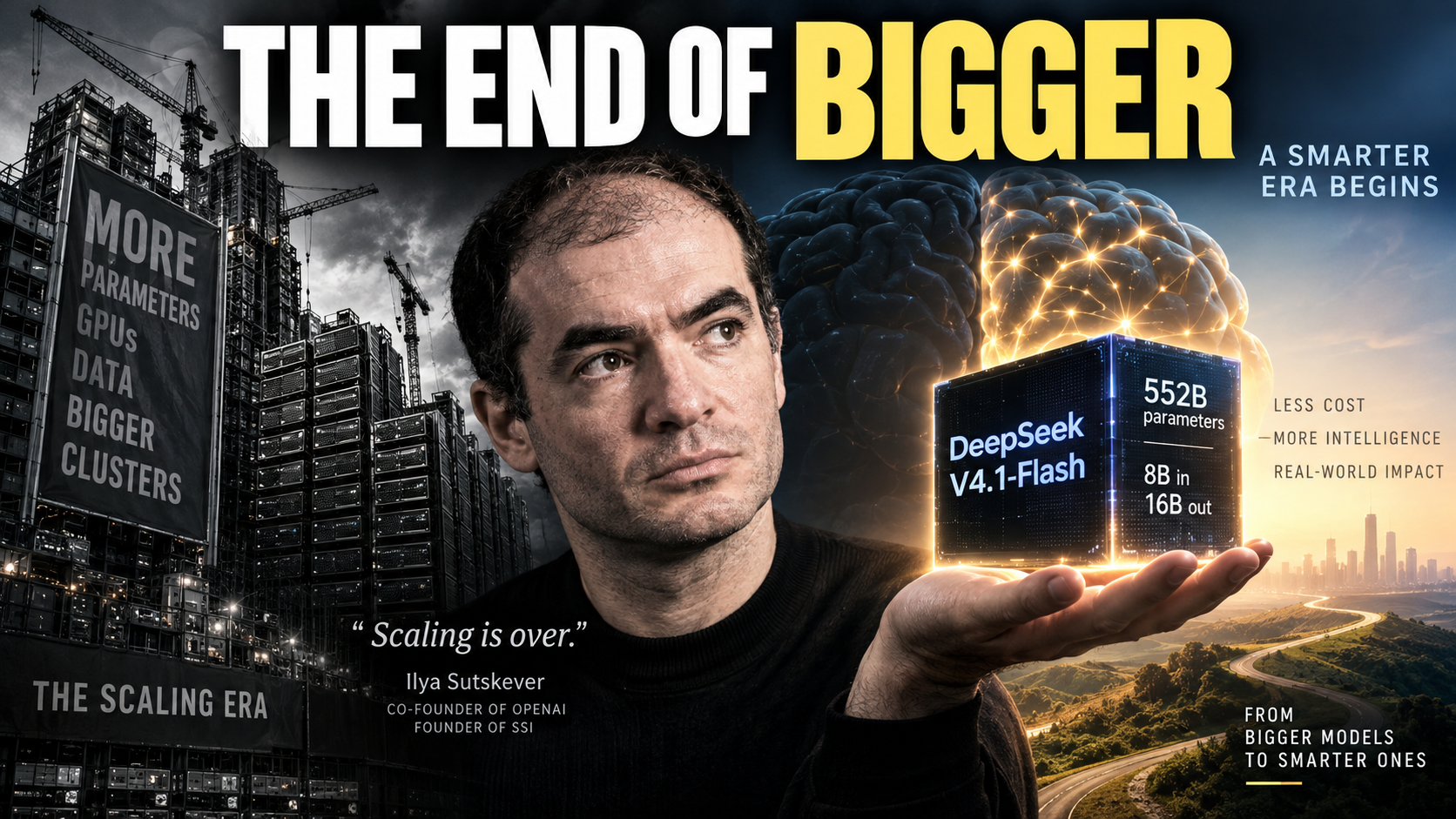
Why the AI race is shifting from raw parameter scale to architectural efficiency and smart resource allocation.
In this issue: Why Ilya Sutskever's prediction about the 'age of research' is unfolding in real time, what DeepSeek V4.1-Flash tells us about the economics of intelligence, and why efficiency is democratizing AI.
There is a moment in every technological revolution when we suddenly realize that we have been asking the wrong question.
For the last five years, the question in artificial intelligence seemed obvious:
How big can we make the model?
More parameters. More GPUs. More data. More computing power. Bigger training clusters. Bigger models.
The assumption was almost intuitive: if we wanted smarter machines, we simply had to build larger ones.
But perhaps that era is coming to an end.
And what makes this particularly interesting is that one of the people who helped build the scaling era was already warning us about it.
Ilya Sutskever, co-founder of OpenAI and one of the central figures in modern AI research, left OpenAI and founded Safe Superintelligence, or SSI. In November 2025, in a conversation with Dwarkesh Patel, Sutskever described the industry as moving away from the "age of scaling" and toward an "age of research."
At the time, that sounded like a philosophical observation.
Now it is beginning to look like an engineering prediction.
The scaling problem
The logic behind scaling was extraordinarily powerful.
Give a neural network more parameters.
Give it more training data.
Give it more computing power.
The model gets better.
And for several years, that relationship worked remarkably well.
The AI industry therefore built an enormous economic machine around it.
The competitive advantage became the size of the data center.
Who had more GPUs?
Who could train a larger model?
Who could spend billions of dollars on infrastructure?
Who could obtain more data?
The answer to those questions increasingly determined who could build the most capable AI.
But there is an obvious problem.
There is only so much high-quality human-generated information available.
There are only so many useful books, scientific papers, websites, conversations, images and pieces of code.
You cannot keep doubling the amount of meaningful human knowledge forever.
At some point, you run into the wall.
And that is where Sutskever's argument becomes important.
The next generation of AI may not come primarily from making the machine bigger.
It may come from making the machine better at using what it already has.
Enter DeepSeek
This week, DeepSeek gave us a rather spectacular demonstration of that idea.
Its new V4.1-Flash model has a total architecture of 552 billion parameters.
That sounds enormous.
But here is the interesting part.
It does not activate all of those parameters for every token.
Depending on the operation, it activates roughly 8 billion parameters when processing input and 16 billion parameters when generating output.
Think about that for a moment.
The model has a huge brain, but it does not wake up the entire brain every time you ask it a question.
It selectively uses what it needs.
That is not merely a question of making a smaller model.
It is a different way of thinking about computation.
And it resembles something we already see in biology.
When you and I solve a problem, our entire brain is not performing every possible calculation simultaneously.
Different neural circuits become involved depending on the task.
The intelligence is not simply in the number of neurons.
It is also in how efficiently the system recruits them.
That distinction may become one of the most important ideas in AI over the next decade.
Smaller does not necessarily mean weaker
There is another detail here that I find particularly revealing.
DeepSeek says that V4.1-Flash is outperforming its much larger V4-Pro model on several important agentic workloads. Its published results include a 74.2 score on DeepSWE v1.1, compared with 62.7 for V4-Pro.
And this is not some academic benchmark measuring an obscure mathematical curiosity.
These evaluations increasingly try to answer a more practical question:
Can the model actually do something?
Can it write code?
Can it operate tools?
Can it navigate complex workflows?
Can it maintain context?
Can it function as an agent rather than simply produce an impressive paragraph?
That is a much more interesting measure of intelligence.
Because eventually, we are not going to pay AI systems because they can tell us how intelligent they are.
We are going to pay them because they can get things done.
And then DeepSeek did something even more interesting
On September 14, DeepSeek began routing requests for its V4-Pro model to V4.1-Flash instead, until the next Pro version arrives.
In other words, the company essentially said:
"Why are you asking for the bigger model? The smaller one is doing the job better."
That is a remarkable statement.
Imagine if Intel announced that its low-power processor was outperforming its flagship chip on the workloads customers actually care about—and therefore the flagship was going to be quietly retired.
That would get everyone's attention.
And it should.
Because the important competition in AI may no longer be:
Who has the biggest model?
It may become:
Who can produce the most intelligence per dollar, per watt, per GPU and per second?
That is a completely different race.
The economics of intelligence
This matters enormously because artificial intelligence is ultimately an economic technology.
A model that is 10 percent smarter but costs ten times more to operate may not win the market.
A model that is slightly less impressive on a laboratory benchmark but costs a fraction as much—and can run thousands of agents simultaneously—may be much more valuable.
This is why DeepSeek's architectural decisions matter.
The company says V4.1-Flash reduces the memory requirements of its KV cache to one quarter of the previous generation's HBM requirement and one eighth of the SSD storage requirement.
Those numbers may sound like engineering details.
They are not.
They translate directly into infrastructure costs.
And infrastructure costs determine who can deploy AI at scale.
The lesson I take from all this
I don't think this means that large models are dead.
That would be another form of technological exaggeration.
The future will almost certainly contain enormous models.
DeepSeek itself still has a V4-Pro architecture with 1.6 trillion total parameters and 49 billion active parameters.
The lesson is different.
Size is no longer the only axis of progress.
We are entering an era in which architecture, reasoning, training methods, reinforcement learning, memory management, routing and inference efficiency may matter as much—or sometimes more—than raw parameter count.
And that changes the entire philosophy of AI development.
For five years, the metaphor was the factory.
Build a bigger factory.
Buy more machines.
Train a bigger model.
For five years, the metaphor was the factory: Build a bigger factory. Buy more machines. Train a bigger model. Now the metaphor may be the brain: Don't simply build more neurons. Learn how to use them better.
And this is where Ilya Sutskever's prediction becomes interesting
When Sutskever said that we were moving from the age of scaling to the age of research, I don't think he meant that scaling would suddenly stop.
He meant something more subtle.
The easy gains were beginning to disappear.
The next gains would require understanding.
Understanding how models generalize.
How they reason.
How they learn.
How they use tools.
How they interact with the environment.
How they learn from their own experience.
How we can make them more capable without simply throwing another thousand GPUs at the problem.
That is research.
And perhaps that is the real transition we are witnessing.
We may have reached the moment when intelligence becomes an engineering problem
For most of the history of computing, our instinct was to make machines faster.
Then we learned to make them smaller.
Then we learned to make them more efficient.
Artificial intelligence may be going through the same evolution.
First came scale.
Now comes efficiency.
And after efficiency comes something even more interesting:
coordination.
Instead of asking how large one model can become, we may increasingly ask how many specialized models can cooperate, how they can use tools, how they can learn from feedback, and how intelligently we can allocate computation.
That is a very different future.
And, frankly, I find it much more exciting.
Because if intelligence becomes less dependent on gigantic data centers and more dependent on better algorithms, better architectures and better research, the AI revolution becomes accessible to many more people.
It moves from the exclusive domain of companies capable of spending billions of dollars on computing infrastructure toward something closer to what happened with personal computing and the Internet.
The technology becomes democratized.
And that, in my opinion, may be the real story behind DeepSeek V4.1-Flash.
Not that DeepSeek built a smaller model.
But that it may be showing us that the future of AI is not necessarily about building bigger brains.
It may be about building smarter ones.
Dr. Jose A. Cisneros, MD,PhD
Enjoyed this piece?
If you found this analysis valuable, share it with your network or subscribe to receive future deep dives on AI, technology, and computing economics directly in your inbox.
Subscribe to the Newsletter | Share this Article